VidoPay vs. Traditional Micro-Job Sites: Why Social Video Sharing Outperforms Clicks
Published by VidoPay Strategy Team on July 2026
For over a decade, traditional micro-task platforms have served as common starting points for online earners. However, these legacy systems—relying heavily on fixed clicks, forced sign-ups, and automated tasks—are increasingly failing to deliver genuine value to advertisers and fair income to workers.
VidoPay.net represents a shift in this space. By replacing mechanical, low-value clicks with organic social video sharing (Shorts, Reels, TikTok), VidoPay builds a healthier marketplace where advertisers pay for real human attention and creators earn in proportion to their actual reach.
The Core Limitations of Click-Based Micro-Job Sites
Legacy micro-task networks operate on a repetitive structure. Workers are asked to click an ad, search a keyword on Google, or complete a forced sign-up form. While simple, this framework presents major issues:
- Minimal Worker Compensation: Click tasks generally pay mere pennies—typically $0.02 to $0.05 per action—making it difficult for workers to build meaningful part-time income.
- Low Value for Advertisers: Visitors driven by forced clicks usually close the page instantly. This high bounce rate signals search engines that the page has poor quality, resulting in no actual conversions for advertisers.
- No Professional Growth: Mechanically clicking links develops no transferable digital skills, leaving workers trapped in repetitive, low-wage cycles.
How VidoPay's Peer-to-Peer Video Model Disrupts the Cycle
VidoPay approaches micro-jobs through a peer-to-peer advertising framework. Instead of asking creators to click passively, we invite them to build.
Creators review campaign briefs, produce short 15-to-60-second video promos, and share them on their own YouTube, TikTok, or Meta feeds. Because the reward system is based on a **CPM (Cost Per Mille) model**, creators are compensated directly for the volume of real human views they generate. For instance, generating 10,000 views on a $2.00 CPM campaign yields $20.00 USD—something traditional click sites cannot match.
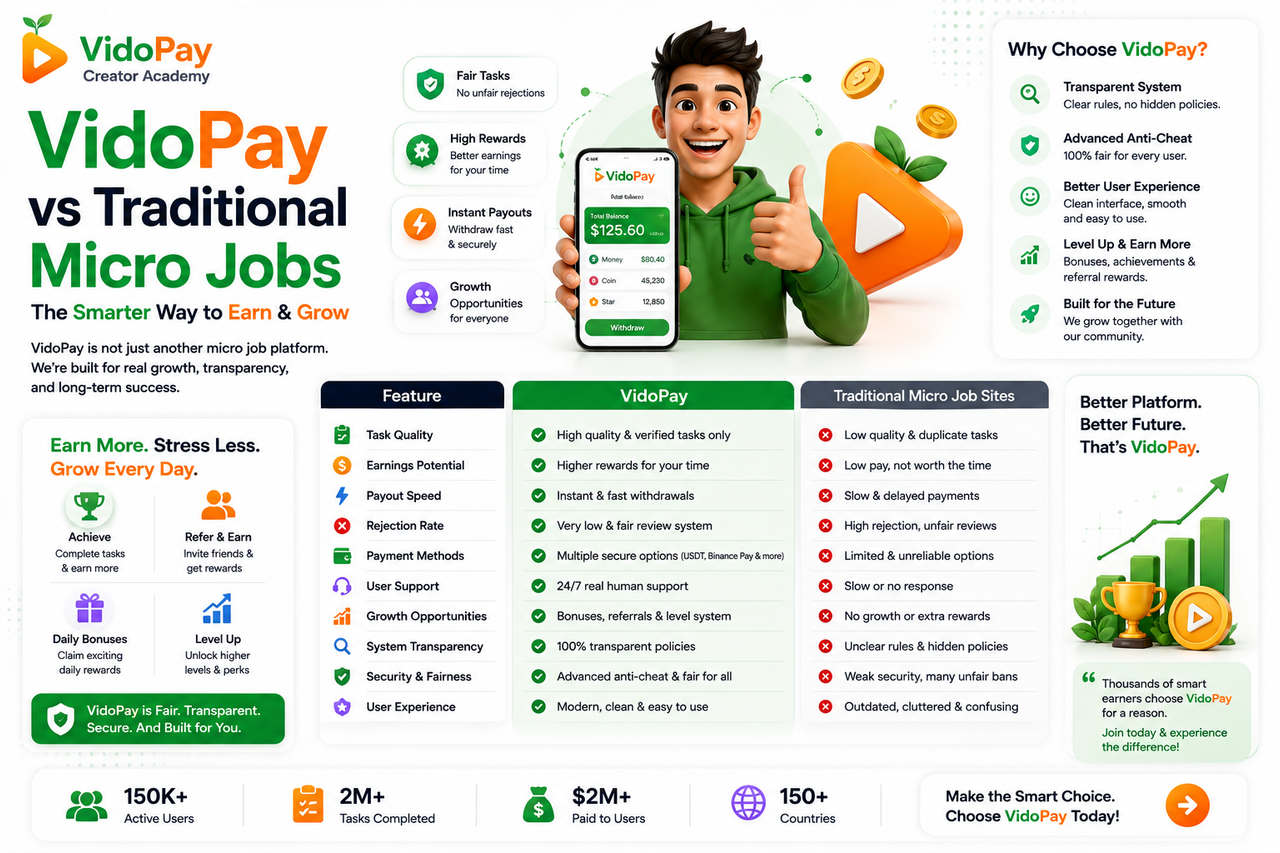
Comparing VidoPay vs. Traditional Micro-Task Platforms
| Feature | Traditional Click Sites | VidoPay Model |
|---|---|---|
| Primary Task Type | Clicking, searching, forced sign-ups | Organic video creation and sharing |
| Income Structure | Flat rate ($0.02 - $0.05 per action) | CPM-based (scaling with actual views) |
| Advertiser Value | High bounce rates, robotic clicks | Targeted, human-approved recommendations |
| Anti-Fraud Protection | Basic IP filtering (vulnerable to bots) | Device fingerprinting & manual audits |
| Skill Development | None (repetitive copy-pasting) | Video editing, script writing, marketing |
Why the Shift Benefits Both Sides of the Marketplace
Transitioning to an organic video promotion model creates a more balanced ecosystem:
Advertisers are protected because they no longer pay for silent, passive clicks. Instead, they secure animated recommendations from real content creators. On the other hand, creators learn high-demand technical skills like scriptwriting, video editing, and algorithm optimization—skills that are highly valuable in today's digital economy.
Step Into the Future of Digital Income
Stop spending hours for pennies. Build valuable skills and earn in proportion to your actual campaign reach on VidoPay.